Healthcare can feel confusing, rushed, and full of words you do not use in everyday life. If you have ever left an appointment thinking, “Wait… what did they just say?” you are not alone. That is exactly why health literacy matters.
Health literacy is “the degree to which individuals have the capacity to obtain, process, and understand basic health information and services needed to make appropriate health decisions” (Centers for Disease Control and Prevention [CDC], n.d.). In other words, it is your ability to understand what is happening in your care and to use that information to make good decisions. When health literacy is low, people are more likely to be hospitalized, use fewer preventive services, and struggle more with chronic conditions (Institute of Medicine, 2004). The good news is that you can improve your health literacy quickly with a few simple habits.
What an “A+ patient” really means
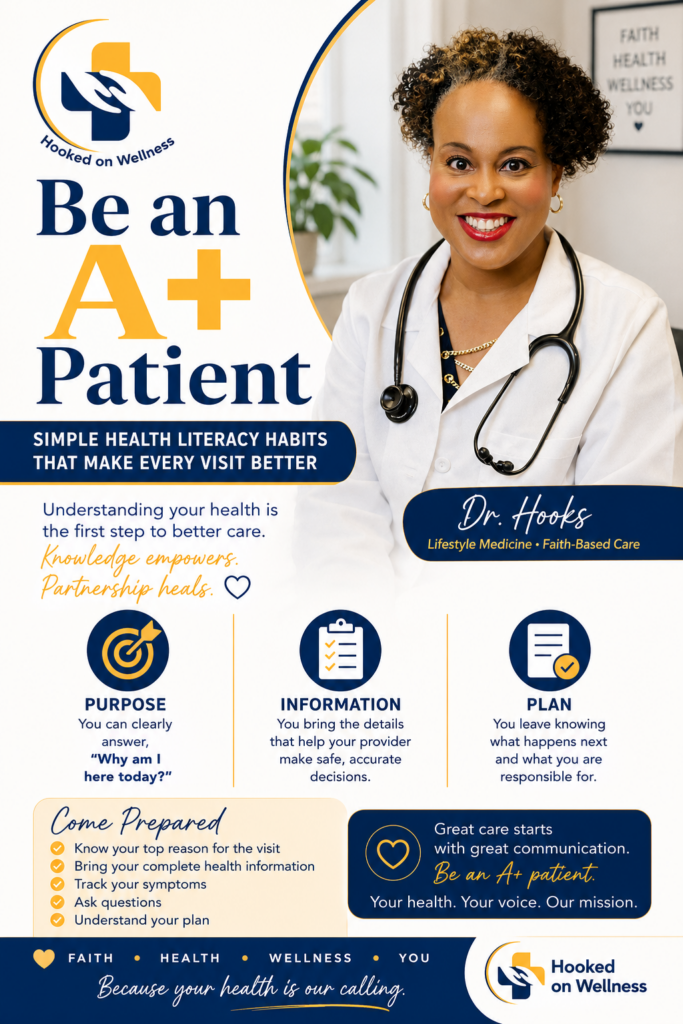
At Hooked on Wellness Clinic, we teach patients to be an “A+ patient.” That does not mean you have to be perfect. It means you show up with three things: purpose, information, and a plan.
Plan: You leave knowing what happens next and what you are responsible for.
Purpose: You can clearly answer, “Why am I here today?”
Information: You bring the details that help your provider make safe, accurate decisions.
When you come prepared, your visit becomes more productive, more efficient, and a better use of your time.
The number one time-waster: “I feel icky”
One of the biggest barriers to great care is vague symptom descriptions. Patients often say things like “I feel yucky,” “I feel off,” or “I just do not feel right.” I understand what you mean, but those words do not give your provider enough information to connect the dots.
Instead, turn feelings into medical clues. Before your visit, try to answer:
- Where do you feel it?
- What does it feel like (burning, pressure, sharp, cramping, tightness, nausea, dizziness, fatigue)?
- How bad is it on a 0 to 10 scale?
- When did it start?
- How often does it happen and how long does it last?
- What triggers it (food, stress, activity, time of day)?
- What helps (rest, water, medication, heat, ice)?
If you struggle to find the right words, you can use a search engine or AI as a “word finder” to help you identify the best term for communication. This is not for self-diagnosis. It is simply to help you describe what you are experiencing more clearly.
Bring a symptom journal: your timeline is powerful
If your symptoms come and go, a symptom journal can be one of the most helpful tools you bring to your appointment. Even three to five days of notes can reveal a pattern.
For each episode, write:
- Date and time
- What happened (your words)
- Severity (0 to 10)
- What you were doing right before it started
- What you ate or drank (if relevant)
- How long it lasted
- What helped
- Anything else you noticed (stress, sleep, menstrual cycle, new foods, new medications)
This turns “I feel off” into a clear story your provider can act on.
The “bring it with you” checklist
To make your visit smoother, come prepared with the information your provider typically needs:
- Best phone number, best email, and preferred pharmacy
- Your number one reason for the visit (your top priority)
- A clear timeline of the problem (when it started, how often, what makes it better or worse, what you already tried)
- A complete medication list (prescriptions, over-the-counter medications, vitamins, supplements)
- Medical history (conditions, allergies, hospitalizations)
- Family history (major conditions in close relatives)
- Surgical history (what and when)
- Preventive care dates when applicable (mammogram, Pap smear, colonoscopy, prostate exam)
Practical tips that make a big difference
A few small choices can dramatically improve your appointment:
- Pick your top one to two priorities. If you bring six major issues, we may need follow-up visits to address them safely.
- Arrive on time. Late check-ins reduce what we can cover.
- Ask for plain language. If something is not clear, say, “Can you explain that in a simpler way?”
- Use teach-back. Before you leave, repeat the plan in your own words: “Here is what I am going to do next.” This helps confirm you and your provider are on the same page.
Ready to be an A+ patient?
Your health is too important to leave to confusion. The goal is not perfection. The goal is partnership. If you want more personalized, lifestyle medicine-focused care in a faith-based environment, we would love to support you.
If you are a patient at Hooked on Wellness Clinic, bring your medication list and start a symptom journal today. If you are new here, schedule a visit and let us help you build a clear plan for your health.
Disclaimer: This content is for educational purposes only and is not a substitute for professional medical advice. Always consult your healthcare provider before making health decisions.
References
- Centers for Disease Control and Prevention. (n.d.). Health literacy: Accurate, accessible and actionable health information for all. https://www.cdc.gov/healthcommunication/pdf/audience/healthliteracy.pdf
- Institute of Medicine. (2004). Health literacy: A prescription to end confusion. Washington, DC: The National Academies Press.
- U.S. Department of Health and Human Services. (2010). Healthy People 2010: Understanding and improving health (2nd ed.). Washington, DC: U.S. Government Printing Office.
Important Disclaimer:
This guidance is for educational purposes only and does not replace individualized medical or mental health care. Please consult your personal healthcare provider for any medical concerns.